Reviewed by veterinary and breeder resources. Information compiled from breed experts, responsible hybrid breeders, and canine health organizations.
The Mini Golden Retriever has quickly become one of the most sought after designer dogs in North America. It offers many of the lovable traits that make the Golden Retriever one of the world’s most popular breeds, but in a smaller, more manageable package.
For families living in apartments, smaller homes, or urban environments, the idea of owning a dog with the affectionate personality of a Golden Retriever without the size can be incredibly appealing. However, before bringing one home, it is important to understand exactly what a Mini Golden Retriever is, how much it costs, what health concerns to watch for, and whether this hybrid breed fits your lifestyle.
This complete guide covers everything prospective owners need to know, from choosing an ethical breeder to grooming, nutrition, exercise, and training.
Quick Summary
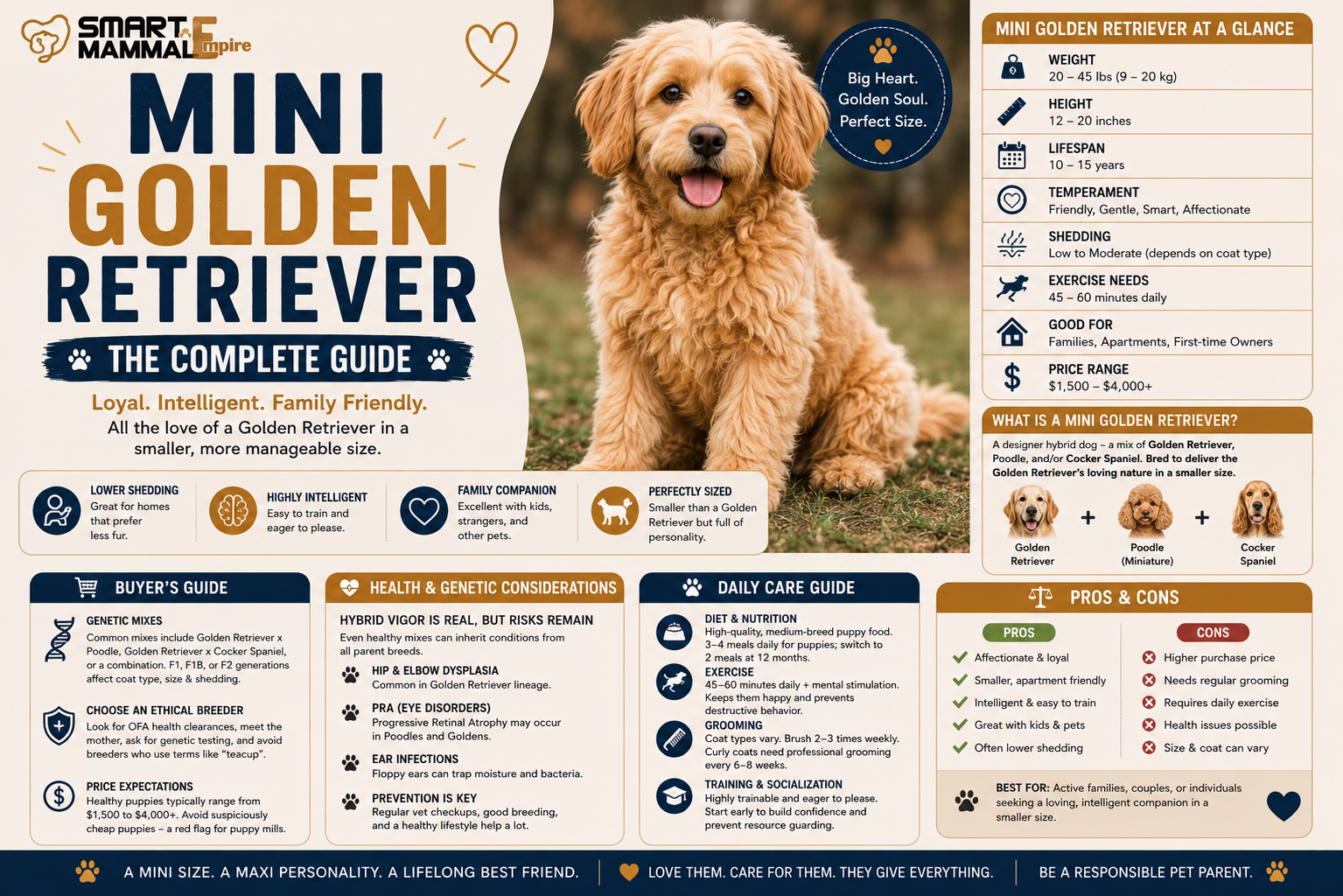
| Feature | Details |
|---|---|
| Breed Type | Designer Hybrid |
| Parent Breeds | Golden Retriever, Poodle, and/or Cocker Spaniel |
| Weight | 20–45 pounds (9–20 kg) |
| Height | 12–20 inches |
| Lifespan | 10–15 years |
| Temperament | Friendly, intelligent, affectionate |
| Shedding | Low to moderate |
| Exercise Needs | Moderate to high |
| Good with Children | Yes |
| Apartment Friendly | Yes, with daily exercise |
What Is a Mini Golden Retriever?
Despite the name, a Mini Golden Retriever is not a naturally occurring miniature version of a purebred Golden Retriever.
Instead, it is an intentionally developed hybrid dog created by crossing a Golden Retriever with smaller breeds such as the Poodle and Cocker Spaniel. Breeders developed the Mini Golden Retriever to preserve the Golden Retriever’s friendly personality while reducing overall size and, in some cases, shedding.
Because this is a hybrid breed rather than a recognized purebred, individual puppies can vary significantly in appearance, size, coat texture, and temperament.
Most Mini Golden Retrievers inherit:
- The friendly personality of the Golden Retriever
- The intelligence of the Poodle
- The compact size of the Cocker Spaniel or Miniature Poodle
- A soft, attractive coat
- Strong family-oriented behavior
Their adaptability has made them increasingly popular among first time dog owners, families with children, and seniors looking for a manageable companion.
Part 1: The Buyer’s Guide
Understanding the Genetic Breakdown
One of the most important things a potential buyer should understand is how Mini Golden Retrievers are bred.
Not all Mini Golden Retrievers are created equally.
F1 Generation
An F1 Mini Golden Retriever is the direct offspring of two different parent breeds.
For example:
- Golden Retriever × Miniature Poodle
- Golden Retriever × Cocker Spaniel
These puppies often display greater genetic diversity and may benefit from hybrid vigor.
F1B Generation
An F1B dog is produced when an F1 Mini Golden Retriever is bred back to a Poodle.
This generation often has:
- Curlier coats
- Less shedding
- Higher allergy friendliness
F2 Generation
F2 puppies result from breeding two F1 Mini Golden Retrievers together.
These dogs can display greater variation in:
- Size
- Coat type
- Temperament
- Energy level
Understanding the generation helps buyers predict what type of dog they may be bringing home.
Size and Appearance Predictions
Mini Golden Retrievers are generally much smaller than standard Golden Retrievers.
Typical Size
Weight:
20–45 pounds (9–20 kg)
Height:
12–20 inches
Because they inherit traits from multiple breeds, exact size predictions can be difficult.
Some puppies resemble miniature Golden Retrievers, while others inherit curlier coats and leaner builds from their Poodle ancestry.
Coat Types
Mini Golden Retrievers can have:
- Straight coats
- Wavy coats
- Curly coats
Common coat colors include:
- Golden
- Cream
- Apricot
- Red-gold
- Light tan
How Much Does a Mini Golden Retriever Cost?
The price of a Mini Golden Retriever can vary significantly depending on breeder reputation, location, health testing, and pedigree.
Average Puppy Price
Most healthy Mini Golden Retriever puppies cost:
$1,500–$4,000
Premium bloodlines with extensive health testing may cost even more.
Why Cheap Puppies Are a Red Flag
If you find a Mini Golden Retriever puppy advertised for only a few hundred dollars, proceed with caution.
Low prices often indicate:
- Puppy mills
- Backyard breeders
- Lack of health testing
- Poor socialization
- Unethical breeding practices
A reputable breeder invests heavily in health screenings, veterinary care, nutrition, and responsible breeding programs.
How to Choose an Ethical Breeder
Finding a responsible breeder is one of the most important decisions you’ll make.
Look for OFA Certifications
Ethical breeders should provide Orthopedic Foundation for Animals (OFA) clearances for parent dogs.
These certifications help reduce the risk of inherited joint disorders.
Ask for documentation regarding:
- Hip evaluations
- Elbow evaluations
- Cardiac screenings
- Eye examinations
Meet the Mother Dog
A trustworthy breeder should allow you to:
- Meet the mother
- Observe her temperament
- Evaluate living conditions
If distance is an issue, request a live video tour.
Ask for Genetic Testing Results
Responsible breeders openly share genetic health testing reports.
Avoid breeders who:
- Refuse to provide documentation
- Become defensive when asked questions
- Cannot explain their breeding program
Beware of Marketing Buzzwords
Terms such as:
- Teacup Mini Golden Retriever
- Pocket Golden Retriever
- Rare Micro Golden Retriever
are often marketing gimmicks designed to justify inflated prices.

Part 2: Health and Genetic Considerations
Hybrid Vigor vs. Genetic Risk
Many people assume mixed breeds are automatically healthier than purebred dogs.
While hybrid vigor can reduce some inherited risks, no dog is completely immune to genetic disorders.
Mini Golden Retrievers can inherit health conditions from all parent breeds.
This is why responsible breeding and health testing remain essential.
Hip and Elbow Dysplasia
Golden Retrievers are prone to joint problems, particularly hip and elbow dysplasia.
Symptoms may include:
- Limping
- Difficulty standing
- Reduced activity
- Stiffness after exercise
Maintaining a healthy weight and purchasing from OFA-tested lines can significantly reduce risk.
Progressive Retinal Atrophy (PRA)
PRA is a hereditary eye disease found in both Golden Retrievers and Poodles.
This condition gradually causes vision loss and can eventually lead to blindness.
Responsible breeders screen breeding dogs for PRA before producing litters.
Ear Infections
Floppy ears create a warm, moist environment that encourages bacterial growth.
Because Mini Golden Retrievers often inherit floppy ears from Goldens and Cocker Spaniels, they can be prone to recurring ear infections.
Owners should:
- Check ears weekly
- Keep ears dry after swimming
- Clean ears using veterinarian-approved products
Additional Health Concerns
Other conditions occasionally seen include:
- Allergies
- Patellar luxation
- Heart disease
- Obesity
- Hypothyroidism
Routine veterinary visits help detect issues early.
Part 3: The Complete Care Guide
Diet and Nutrition
Proper nutrition plays a major role in long-term health.
Puppy Feeding
Choose a high-quality medium-breed puppy food formulated to support healthy growth.
Puppies should typically eat:
- 3–4 meals daily until 6 months
- 2–3 meals daily from 6–12 months
Adult Feeding
Most adult Mini Golden Retrievers do well with:
- Two meals per day
- Balanced protein sources
- Controlled calorie intake
Avoid overfeeding, as excess weight places stress on joints.
Exercise Requirements
Mini Golden Retrievers may be smaller than standard Goldens, but they remain active dogs.
Daily Exercise Needs
Most require:
45–60 minutes of exercise per day
Suitable activities include:
- Walks
- Fetch
- Hiking
- Swimming
- Puzzle toys
Without sufficient activity, they may develop:
- Excessive barking
- Destructive chewing
- Separation anxiety
Mental stimulation is just as important as physical exercise.
Grooming Requirements
Grooming needs vary depending on coat type.
Poodle Type Coats
Dogs with curlier coats often need:
- Professional grooming every 6–8 weeks
- Frequent brushing
- Regular trimming
Golden or Spaniel-Type Coats
Straighter coats require:
- Brushing at least three times weekly
- Seasonal shedding management
- Routine bathing
Regular grooming helps prevent painful matting and skin irritation.
Training and Socialization
One of the breed’s biggest strengths is its intelligence.
Mini Golden Retrievers are highly trainable and eager to please.
Training Tips
Use:
- Positive reinforcement
- Consistency
- Short training sessions
- Food rewards
Harsh corrections are rarely necessary.
Early Socialization
Socialization should begin during puppyhood.
Expose your dog to:
- Different people
- New environments
- Other dogs
- Sounds and surfaces
Early socialization helps build confidence and reduce fear based behaviors.
Preventing Resource Guarding
Some Spaniel lines may show mild resource guarding tendencies.
Teaching puppies to comfortably share toys, food, and space can help prevent future issues.
Is the Mini Golden Retriever Right for You?
Before choosing any dog, it is important to evaluate your lifestyle honestly.
Mini Golden Retrievers thrive in homes that can provide:
- Daily exercise
- Consistent training
- Family interaction
- Regular grooming
They are not ideal for owners seeking a completely low maintenance pet.
ReadMore: Full Grown Mini Goldendoodle- Complete Size Guide
Mini Golden Retriever Pros and Cons
Pros
✓ Friendly and affectionate personality
✓ Smaller than a standard Golden Retriever
✓ Highly intelligent and trainable
✓ Excellent family companion
✓ Generally good with children
✓ Adaptable to apartments and smaller homes
✓ Often sheds less than a Golden Retriever
Cons
✗ Can be expensive to purchase
✗ Requires regular grooming
✗ Needs daily exercise and mental stimulation
✗ May inherit health issues from parent breeds
✗ Separation anxiety can develop if left alone too long
✗ Coat type and adult size can be difficult to predict
Frequently Asked Questions
What is a Mini Golden Retriever?
A Mini Golden Retriever is a designer hybrid dog created by crossing a Golden Retriever with a Miniature Poodle and/or Cocker Spaniel. The goal is to retain the Golden Retriever’s friendly personality in a smaller, more manageable size.
How big does a Mini Golden Retriever get?
Most Mini Golden Retrievers weigh between 20 and 45 pounds (9–20 kg) and stand about 12–20 inches tall. Their exact size depends on genetics and the breeds used in the breeding program.
Are Mini Golden Retrievers good family dogs?
Yes, Mini Golden Retrievers are known for their affectionate, gentle, and social nature. They usually get along well with children, other pets, and family members, making them excellent companion dogs.
Do Mini Golden Retrievers shed?
Shedding varies depending on their coat type. Dogs with more Poodle genetics tend to shed less, while those with stronger Golden Retriever traits may shed moderately throughout the year.
How much exercise does a Mini Golden Retriever need?
Mini Golden Retrievers typically require 45–60 minutes of daily exercise. Regular walks, playtime, and mental stimulation help prevent boredom and maintain their physical and emotional well-being.
Are Mini Golden Retrievers easy to train?
Yes, they are highly intelligent and eager to please. Positive reinforcement training methods work exceptionally well, and early socialization helps them develop into confident and well-behaved adult dogs.
What is the lifespan of a Mini Golden Retriever?
The average lifespan of a Mini Golden Retriever is between 10 and 15 years. Proper nutrition, regular exercise, routine veterinary care, and responsible breeding can contribute to a longer, healthier life.
How much does a Mini Golden Retriever cost?
A Mini Golden Retriever puppy typically costs between $1,500 and $4,000 from a reputable breeder. Prices may vary depending on bloodline, health testing, location, and breeder reputation.
Are Mini Golden Retrievers good for apartment living?
Yes, their smaller size makes them more suitable for apartments than standard Golden Retrievers. However, they still need daily exercise, training, and mental enrichment to stay happy and healthy.
What health problems can Mini Golden Retrievers have?
Mini Golden Retrievers may inherit conditions such as hip dysplasia, elbow dysplasia, Progressive Retinal Atrophy (PRA), and ear infections. Choosing a breeder who performs genetic health testing can help reduce these risks.
Final Verdict
The Mini Golden Retriever combines many of the qualities dog lovers adore about the Golden Retriever with a more manageable size suited for modern living. Friendly, intelligent, affectionate, and highly trainable, these dogs make excellent companions for active families, couples, and individuals willing to invest time in training and care.
However, prospective owners should remember that Mini Golden Retrievers are designer hybrids, not a standardized breed. Choosing an ethical breeder, reviewing health clearances, and understanding grooming and exercise requirements are essential steps before bringing one home.
If you’re looking for a loving family companion with a big personality in a smaller package, the Mini Golden Retriever may be the perfect addition to your home.
Have questions about Mini Golden Retrievers or already own one? Share your experience in the comments and help future owners make informed decisions.
Author


Related Posts